
Bandag: why retreading is top of the agenda
 In a commercial landscape defined by rising costs, supply chain pressures and tightening sustainability targets, fleets are being forced to rethink how they manage tyres, says Bandag.
For the retreading specialist, the answer lies not in buying more, but in making better use of what fleets already have.
Backed by Bridgestone, Bandag reports that it is regaining momentum across Europe, with renewed investment, leadership and technology placing it firmly back on the radar for HGV, PSV and LCV operators.
At the centre of this renewed focus is Christoph Frost, recently appointed director of Bridgestone’s EMEA Retread Business. With more than 25 years’ experience in the commercial tyre sector, he brings a clear message to the market: retreading is no longer just a cost-saving measure, but a strategic necessity.
“Retreading plays a crucial role in helping fleets manage costs sustainably,” he said.
“If you believe in circularity, reliable local supply chains and lower cost per kilometre, then it has to be part of your strategy.”
With fleets facing increasing pressure from volatile supply chains and the growing presence of low-cost, unproven imports, says Bandag, many are turning back to trusted, premium-led solutions that deliver both performance and predictability.
Bandag’s model is built around three core pillars: high-quality casing supply, long-term fleet partnerships and a network of experienced, locally based dealers, It’s a formula that the firm says has already proven its worth in highly competitive markets, with more than half of the largest fleets in the United States now operating Bandag tyre management programmes.
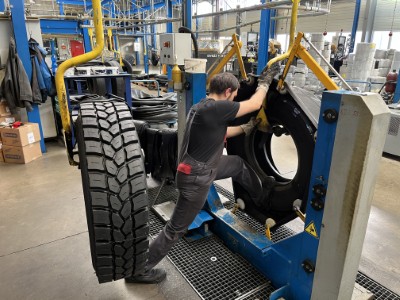 At the heart of the proposition is circularity. Retreading extends the life of a tyre casing, significantly reducing the need for raw materials and cutting CO₂ emissions compared with a new-tyre-only approach. For fleet operators, says Bandag, this translates into lower environmental impact and improved lifecycle efficiency, without compromising on performance.
“The more sustainable we help a fleet become, the less it will spend,” Frost added.
“We want customers to maximise the value of the casings they already own. That’s where the real gains are made.”
Bandag’s Basys platform provides full lifecycle tracking for every casing, from collection through to retreading and refitment. Each tyre is assigned a unique barcode, giving fleets and dealers complete visibility of performance, usage and condition.
For operators, this means access to real-time data, improved planning and greater control over tyre performance. For dealers, it enables more efficient production, reduced administration and improved quality assurance, all of which contribute to lower operating costs and higher service standards.
Bandag retreads are manufactured at Bridgestone’s truck and bus radial facility in Stargard, Poland, where advanced mixing and extrusion technologies – typically reserved for new tyres – are applied to retread products. The result, says Bandag, is a solution engineered for durability, efficiency and consistent performance.