
Tyre maintenance tips from Hankook
 Hankook Tyre UK Ltd has issued advice for vehicle operators on inflation pressure and wheel alignment, including around their impact on tyre wear.
“With safety critical components as tyres, it is vital technicians understand the potential causes of tyre wear,” said the company.
“One of the most important aspects of tyre maintenance is correct tyre inflation – necessary to carry the load and avoid damage. Driving with improper inflation (particularly grossly underinflated or overinflated) is dangerous and can cause critical damage or sudden failure and premature removal from service.
“Hankook therefore suggests that inflation values should be checked at least once a week, and always before a long-distance drive, Indeed, in the space of one month, a tyre can lose up to 10 pounds of air pressure.
“It is also advisable to take into account the axle loadings for the loads imposed, when setting inflation pressures, compensation for heavier loads can be made by increasing inflation pressures – though make sure not to exceed the maximum inflation rates for the tyre, or maximum axle load.”
Underinflation is the worst enemy for tyres, adds the company; it causes increased tread wear on the tyre shoulders, reduces the tread contact area on the road surface and also generates excessive heat affecting the tyres’ durability.
“Soft tyres also make your vehicle work harder, meaning that fuel efficiency is reduced due to increased rolling resistance,” it continued.
“Overinflation, on the other hand, is also detrimental, as too much air pressure causes the centre of the tread to bear the majority of the vehicle’s weight, leading to more rapid wear to the tyre tread centre which will shorten the life span of the tyre and increases the risks the tyre prone to damage from road hazards due to the tyre not being able to dampen the effects of a shock.”
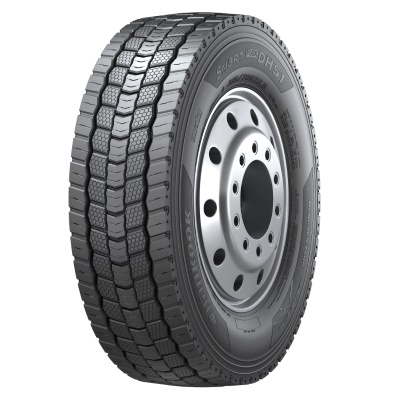 Turning to wheel alignment, says Hankook, there is more to the process than most people understand. Steering axle alignment alone is not sufficient, as the vehicle and all of its tyres are needed to be travelling in the same direction, and it is essential that that all axles are in correct alignment also.
The company outlines the various different components needed to achieve total wheel alignment as follows:
1. Camber
“Camber is the inward or outward tilt of the steering axle tyres when viewed from the front,” said Hankook.
“Positive camber is the top of the tyre tilted out; negative camber is the top of the tyre tilted in.
“The angle that a centre line of the wheel is inclined from the vertical centre line perpendicular to a flat road, is called camber angle.
“If the top of the top of the tyre is tilted out and the wheel leans out from the perpendicular then it is positive camber. If the top of the tyre is tilted in and the wheel leans in from the perpendicular then it is negative camber. Camber becomes more negative as the load increases.
“Camber is meant to compensate for the downward forces of added loads; correct camber settings helps the tyre to maintain a firm and even tread contact with the road while the vehicle is travelling under loaded conditions. Often, one side tyre tread wear can occur on the outside or inside edge of the tyre due to incorrect camber setting.”
2. Toe
“Toe is the inward or outward pointing of the wheels when viewed from the top of the vehicle,” the firm continued.
“The goal is to have zero toe when the vehicle is loaded to its normal operating condition.
“Toe-in refers to the inclination of the wheels of a vehicle so that the pair of front wheels are set inwards facing.
“The purpose of toe-in is to counteract some of the forces which pulls the wheels outwards as they roll along the road under engine power. Correct toe-in will ensure the direction of travel is correct as possible for forward direction of travel; insufficient toe-in settings will result in steering instability.
“If toe-in or toe-out is insufficient or excessive, the tyre wear will certainly be affected and appear as feathering at the edges of the tread.”
3. Caster
Caster is the forward or rearward tilt of the king pin of the steering axle when viewed from the side, explains Hankook.
“Caster is generally not considered to have a great effect on the tyre wear,” it added.
 “Caster is the condition where the king pin is inclined with the top of the pin angled rearward, similar to the front forks of a bicycle. Caster angle is meant to compensate for the resistance of which the tyre(s) encounters as a result of drag forces against the road. Caster angle should be the same for both wheels on a given axle, or the result will be vibration and abnormal tyre wear.
“Too much caster will more than compensate for the amount of drag, but it will also create additional difficulty in steering.
“Too little caster makes steering become lighter, but also unstable. The caster angle should be checked as it can be distorted by impacts on the tyre or by rough driving conditions.”
4. Ackermann
The Ackermann Principle shows that in any turn the inside tyre needs a sharper turn angle than the outside tyre, says Hankook.
“The difference in turn angles between the tyres is determined by the actual turn angle and the vehicle wheelbase.
“Improper Ackermann causes side force, excessive scuffing and fast or irregular wear.”
5. Thrust Angle
“Thrust angle is the difference between the line perpendicular to the axle and vehicle centre line.
“Each drive axle has its own thrust angle.
“The target is to have zero thrust angle.”
6. Tandem Scrub
“Tandem scrub is the difference in the thrust angles of the drive axles.
“The target is zero.
“Tandem scrub errors cause constant side force on the steer tyres, which leads to irregular wear.”
The company added: “It must be noted that tyres are not designed or manufactured to wear unevenly and the wear, handling and mileage performances of the tyres are influenced by the vehicle dynamic set up, mechanical and component wear and the tyre pressures used – so it is important to recognise… that tyres are not a maintenance free component.”