
Beyond recovery: the evolving role of roadside assistance
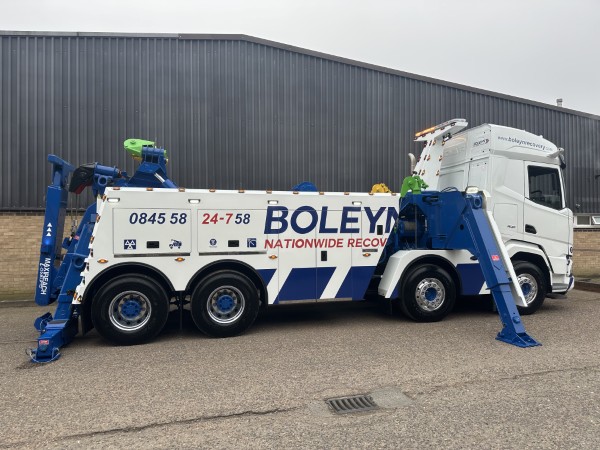
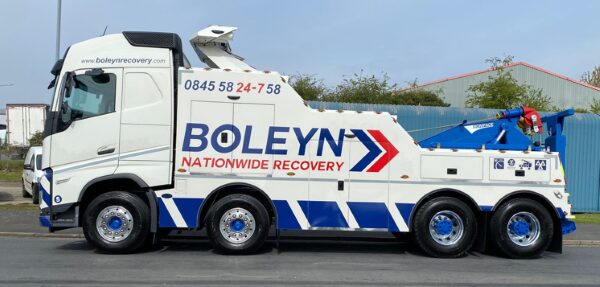
Boleyn Recovery’s so-called ‘Marmite’ truck with RXP legs
Stephen Smith, CEO of Boleyn Recovery & Fleet Services, offers his perspective on the changing face of modern heavy recovery operations
When people think about roadside assistance and vehicle recovery, they often picture a recovery truck arriving at the scene, loading a broken-down vehicle and transporting it away. The reality of modern heavy recovery operations is very different.
At Boleyn Recovery & Fleet Services, recovering the vehicle is often the final stage of an incident rather than the first. Our incident managers regularly attend what is initially reported as a straightforward breakdown or collision only to find themselves undertaking a far wider role. We are often amongst the first resources on scene, assisting emergency services, helping to make incidents safe, assisting the recovery of casualties from inaccessible vehicles, clearing debris, managing hazardous situations and coordinating with multiple stakeholders to reopen roads as quickly and safely as possible.
Many people are surprised to learn that recovery operators frequently perform functions traditionally associated with emergency responders. The difference is that whilst many agencies benefit from significant public funding, specialist recovery operators provide a critical emergency service whilst receiving only a fraction of the recognition or financial support.
The public rarely sees the hours of planning, specialist training, investment and coordination required to safely recover modern commercial vehicles. Nor do they see the role recovery operators play in protecting road users, minimising congestion and supporting emergency services during major incidents.
As vehicle technology evolves, so too must the recovery industry. Electric vehicles are changing what we do and the equipment needed. EVs are heavier than their petrol or diesel equivalent, the weight distribution is different, and there is a risk of the high voltage system being compromised in an accident. In addition, the trucks previously deployed to recover 3.5t Transits are no longer suitable if the customer has moved to the EV option, which allows for 4.25t GVW to keep the same payload. For us, this means we need another 750kg of payload, so the 12t truck we used needed replacing with a 14t truck – so more capital expenditure and more fuel used. We have also had to deliver a lot of EV training, purchase high voltage isolators for safety, and thermal image cameras to check battery temperatures if an EV is damaged. Storage bays for EVs are larger due to the risk of fire, so we can only store one vehicle where we used to have nine, meaning recovery companies are faced with increased charges or less revenue.
Innovation has always been at the heart of what we do, and nowhere is this more evident than with the latest addition to our fleet. Affectionately nicknamed ‘Marmite’ by those who have seen it, our newest recovery vehicle has certainly divided opinion on appearance. Like its namesake, people seem to either love it or hate it.
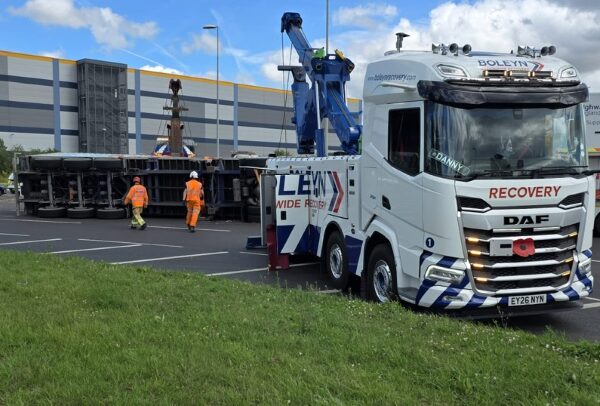
‘Marmite’ on deployment
Boleyn wanted a truck to deal with heavy winching and recovery, so once that spec was agreed, work began with recovery vehicle provider Boniface to select the right chassis to accept the equipment. Boleyn’s first choice was the XF, from our primary partner Harris DAF and luckily it was suitable. The truck has deployable RXP legs at the front to allow side winching and provide greater stability. The leg winches can also be deployed out the rear of the truck, allowing four winch cables to be deployed rearwards so we can roll and catch the casualty vehicle safely with one truck. The installation of the RXPs and side deployment of the winches meant the overall body height needed to be lower than a standard recovery truck. Boleyn decided that the only way forward was to have a single height body front to back, increasing the rear locker capacity and carefully designing a stowage plan. This single height body meant moving away from the traditional step down sides on recovery trucks and was a first for Boniface.
The vehicle generated a high level of discussion before entering service, which continued once more people saw it, but feedback has been overwhelmingly positive regarding its operational capability – so whilst the design is Marmite, nobody disputes its practicality. The vehicle demonstrates that innovation within the recovery sector is not limited to electronics and software. Practical improvements in vehicle design, operator safety, deployment speed and recovery capability continue to transform the service we provide to customers.
Technology is also beginning to reshape the way recovery operators manage jobs and resources. This challenge extends beyond recovery operators themselves. Fleet operators are often caught in a frustrating cycle where job details are repeatedly passed between call centres, manually entered into multiple systems and relayed numerous times between stakeholders before a recovery resource is even deployed. The same information can be captured, re-entered and communicated several times over, creating delays, increasing the risk of errors and ultimately driving up costs for everyone involved.
A traditional-build vehicle with step-down sides
One of the most exciting developments currently underway is FleetRanger, a software platform being developed by Boleyn Recovery specifically for the recovery and commercial fleet owner/management sector. Unlike generic management systems, FleetRanger has been built by recovery operators for recovery operators, connecting them with fleet managers, transport teams, dispatch teams, work providers, insurers, brokers and end users – within a single intelligent platform – all in real time.
The platform is now entering its next phase of development and Boleyn Recovery is actively seeking forward-thinking recovery operators, fleet operators and work providers across the UK to participate in pilot programmes. Early adopters will benefit from reduced or waived administrative charges during the trial period, direct influence over future development and the opportunity to help shape a platform designed to modernise the recovery industry.
Diversification has become increasingly important within the transport sector and at Boleyn Recovery, we have recently expanded into nationwide tyre support through Boleyn Tyres. By combining roadside assistance, recovery, fleet maintenance, testing facilities, tachograph suites and tyre support, we are creating a more comprehensive service offering for customers.
We are also taking delivery later this year of what will be the first Boniface Fusion-bodied Mk6 Interstater in the UK. The Fusion body utilises a moulded fibreglass construction, reducing overall vehicle weight while significantly increasing locker capacity compared with traditional body designs. The vehicle also incorporates a lifting light bar system, improving visibility and safety for operators during loading and recovery operations.