
Tackling CV crime with a multi-layered security approach
by Jonathan Symons
 Commercial vehicle crime represents a growing and costly problem for transport operators. Reported incidents of HGV cargo crime reached 3,424 in 2025, amounting to over nine incidents a day, while over 9,522 vans were reported stolen in the same period and many more broken into to steal tools and equipment.
What is clear is that organised criminal groups are increasingly viewing commercial vehicles as high-value, relatively accessible targets and are becoming more brazen in their techniques.
“The threat to vehicles, trailers, loads, fuel and parts is huge, resulting in hundreds of millions of pounds of losses each year. Commercial vehicle crime can no longer be viewed as an occasional operational loss that transport operators simply absorb,” explains Alejandro Patino, Vice President of Global Sales at Queclink Wireless Solutions.
“This growing security risk now influences where commercial vehicles travel, where drivers can stop, how goods are insured and how much contingency operators need to build into every journey.”
Jason Craven, director of Connected Vehicle Solutions (CVS), explains that commercial vehicle crime represents a serious and often underestimated risk.
“The value of a stolen vehicle, trailer or load is only part of the loss. You also must factor in other associated losses such as operational downtime, missed deliveries, increased insurance premiums and reputational damage. Most importantly, you then need to consider the impact on drivers and their welfare, especially if the theft involves injury or harm.”
Commercial vehicle crime has become more organised, targeted and technology led. Thieves are constantly looking for vulnerabilities to exploit and becoming more selective to maximise returns and success rates, with strategic theft involving deception, impersonation, and cyber scams. There have even been reports of criminal gangs buying legitimate haulage firms, so they can pose as trusted contractors and steal cargo by the truckload.
In fact, trailer hook-up thefts and load fraud, where criminals steal direct from warehouses using cloned vehicles, false identities and forged documentation, are on the rise.

Alejandro Patino of Queclink Wireless Solutions
“Thieves no longer need to target the vehicle directly, identifying other weaknesses within the supply chain. An HGV may be physically secure, but a load can still be diverted or collected because of a stolen identity, compromised network or influencing someone on the inside. Transport operators need to better protect the flow of information around planned deliveries alongside traditional security measures,” suggests Queclink’s Alejandro Patino.
While criminals are exploring new supply chain vulnerabilities, physical theft of HGVs, vans or their loads remains the most common forms of commercial vehicle crime.
According to CVS’ Jason Craven, traditional methods such as stolen keys, forced entry and curtain slashing still make up a significant proportion of incidents, but as security technology improves, so too do the tactics.
“We are seeing greater use of relay devices, key-emulation equipment, signal jammers and electronic tools, which means transport operators cannot simply install a solution once and assume the risk has been permanently addressed.”
The importance of finding a secure place to park, especially overnight, has never been more important as unsecured laybys, on-street parking and poorly monitored areas leave vehicles vulnerable to physical attack. However, thieves have developed bold techniques to avoid secure parking.
For example, jump-up thefts, where criminals access a stationary or slow-moving vehicle or trailer at traffic lights or when stuck in congestion, are growing more frequent, and there are even reports of high-speed, moving vehicle crime.

Brigade Electronics’ James Tyrrell
“In recent years, there has been an increasing threat from moving freight crime in the United States, targeting vehicles at high speed, but more recently we have seen incidents happening in the UK and mainland Europe,” says James Tyrrell, global telematics lead engineer at Brigade Electronics.
“It demonstrates how daring thieves have become, using multiple vehicles to box-in an HGV and gain access to loads like something out of a Hollywood film. The risks are high, but so are the returns for organised criminals.”
While no single security strategy fits all fleets, every transport operator should assume they will be targeted at some point. The best approach is multi-layered combining people, processes, physical security and technology, designed around how the commercial vehicles are used. The starting point should be a risk assessment covering the vehicle, driver, cargo, routes, parking locations, operating hours, and likely criminal activity.
“By understanding the risk within a transport operation, it is possible to create layers of protection that target the biggest vulnerabilities and threats,” claims CVS’ Jason Craven.
“These might include secure key management, driver training, immobilisation, physical locking systems, cameras, powered vehicle tracking, unpowered asset tracking, door sensors, geo zones and 24-hour monitoring. The available tools and techniques are many and varied, so it is about blending the right combination based on precise requirements.”
Queclink’s Alejandro Patino agrees that the best method of aiding commercial vehicle security is using a combination of different types of solutions.
“From a hardware perspective, a transport fleet should start by asking how someone would most likely steal from their operation. They can then design a system that provides the necessary levels of monitoring, visibility and response.”
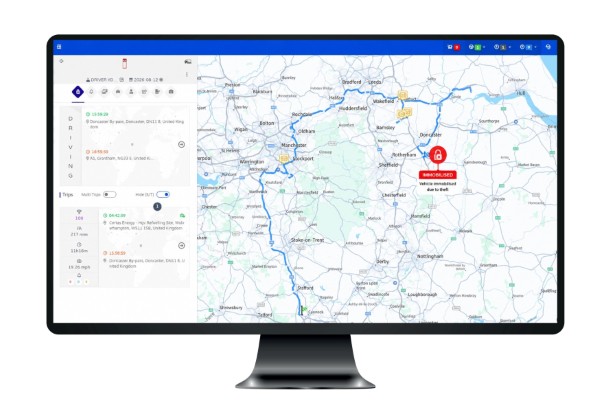
A broad range of technology is now available, ranging from basic vehicle tracking to monitored stolen-vehicle recovery, with additional security features such as driver ID, remote immobilisation, geozoning and tamper detection.
For an added layer of protection, a covert secondary tracker can be deployed, that remains dormant unless the primary device is discovered or disabled. Meanwhile, advances in camera technology and battery-powered trackers offer further opportunity to improve visibility and monitoring.
Brigade Electronics’ James Tyrrell says that transport operators are looking to existing and proven fleet management technologies to tackle specific security threats such as fuel theft or moving vehicle incidents.
“Systems primarily used for safety can play a greater role in preventing vehicle and fuel-related crime. By combining artificial intelligence, camera systems and sensor technology, operators can gain faster alerts and improved visibility when suspicious activity occurs.”
There is growing recognition in the marketplace that the use of AI, connected sensors and behavioural analytics is likely to accelerate in vehicle security. The ability to understand several signals in combination, will help automatically connect events to pinpoint a genuine threat and determine whether intervention is required. It will also enable fleets to better understand and predict threats to their operations.
“Today, a platform might receive an unplanned-stop alert, a cargo-door notification, a camera event and a warning that external power has been disconnected. If these are presented separately, the fleet manager still must determine whether they are connected, but there is now an opportunity to correlate them and identify certain combinations that represent a threat,” suggests Queclink’s Alejandro Patino.

Jason Craven of Connected Vehicle Solutions
CVS’ Jason Craven adds: “The ultimate purpose is to deter the theft, detect suspicious activity quickly and provide the information needed to respond and recover the asset.
“However, prevention is always better and considerably cheaper than dealing with the consequences, so the objective is not simply alerting that as asset has disappeared. It is to identify unusual activity earlier, support a faster response and provide the best possible opportunity to prevent the theft or recover the vehicle, cargo or equipment.”
However, he warns that innovation also brings added risk.
“As vehicles become increasingly connected and there is closer integration of different technologies, digital security will need to be considered alongside traditional physical security. Thatcham Research has highlighted that connectivity introduces a cyber dimension to commercial vehicle crime.”
What is also clear is that in isolation every security technology will eventually lose its advantage over thieves. Once criminals understand how a commonly used device communicates, where it is normally installed or how an operator responds to an alert, they begin designing their attacks around it.
Queclink’s Alejandro Patino explains: “The most valuable innovation will be technology that makes security more adaptive. Devices that change reporting behaviour when tampering is detected; platforms that distinguish a normal signal loss from deliberate interference; or systems that reveal as little as possible about the recovery layer before it is needed.”
Commercial vehicle crime continues to evolve, and so too must the security approaches designed to prevent it. Moving forward, transport operators will need to embrace adaptive, intelligence-driven solutions that anticipate threats before they materialise. By combining hardware innovation, behavioural analytics, and cyber-secure connectivity, operators can take a multi-layered approach that moves from reactive recovery to proactive prevention.
Jonathan Symons is a communications consultant with over 25 years of experience in the telematics sector and working with several major suppliers of fleet technology in the road transport sector.